
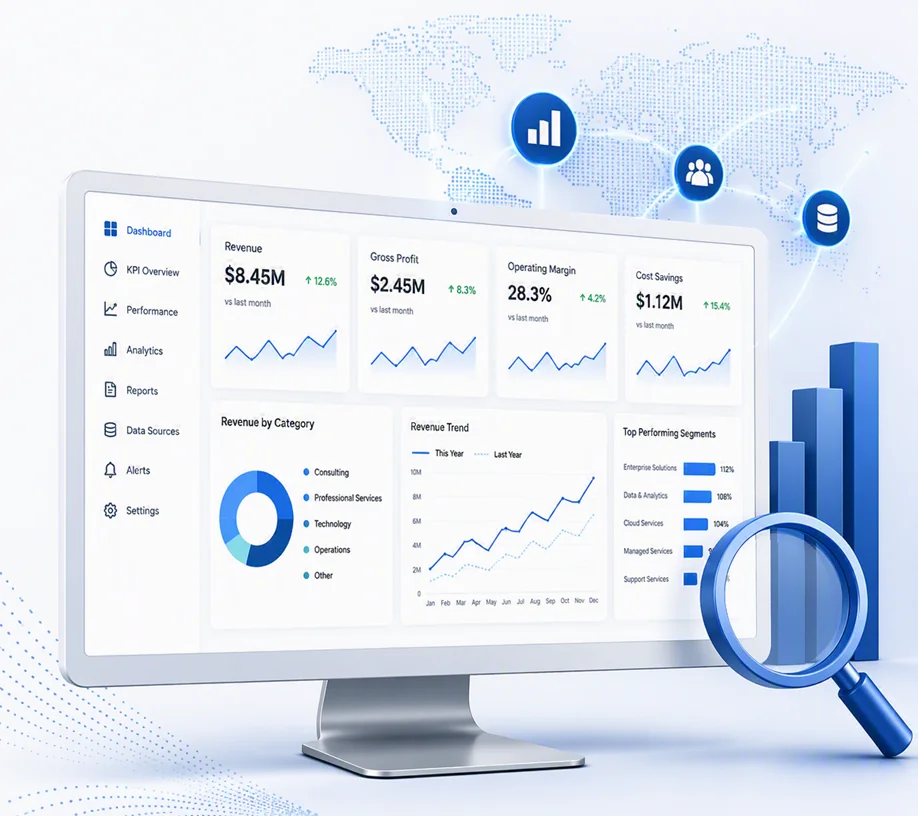
Business Operations Analytics for Accounting Firms

A practical rollout model for operational visibility dashboards, accounting BI governance, and leadership decision cadence.

Business operations analytics dashboard icon

Operational Visibility

Firms improve execution when finance, workflow, and capacity metrics live in one operational BI model.

Business operations analytics gives accounting firms a consistent view of what changed, why it changed, and where leaders should intervene first.

1. Define a leadership KPI layer

Start with business intelligence KPIs that leadership reviews weekly and monthly: realization, utilization, WIP aging, AR aging, throughput, and backlog risk.

2. Build an operational visibility dashboard

Use a role-based layout so partners, firm administrators, and managers can monitor queue health, cycle-time variance, and staffing pressure in real time.

3. Roll out in phases

Phase 1: baseline scorecards. Phase 2: workflow diagnostics. Phase 3: predictive indicators and AI-generated narrative summaries.

Implementation checklist

  • Standardize metric definitions before dashboard publication
  • Assign an owner to each KPI and escalation threshold
  • Review exceptions weekly and root-cause monthly
  • Link financial KPI shifts to workflow and staffing drivers
  • Use custom BI solutions only where differentiated workflow requires it