
How to Identify Unprofitable Clients in a CPA Firm

A client that looks fine on the revenue report can be a losing engagement underneath. The client profitability formula, effective billing rate, cost per engagement, and the signals that flag it before the next renewal.

Client Profitability for Accounting Firms

Most firms know revenue by client. Almost none know profit by client — until a partner asks and nobody has a quick answer.

Revenue per client is easy to pull from any billing system. Profit per client requires netting that revenue against the actual cost of the staff time it took to deliver the work — and that number rarely gets calculated until someone specifically asks why a long-standing client "doesn't feel worth it anymore." By then the firm has usually been subsidizing that client for years.

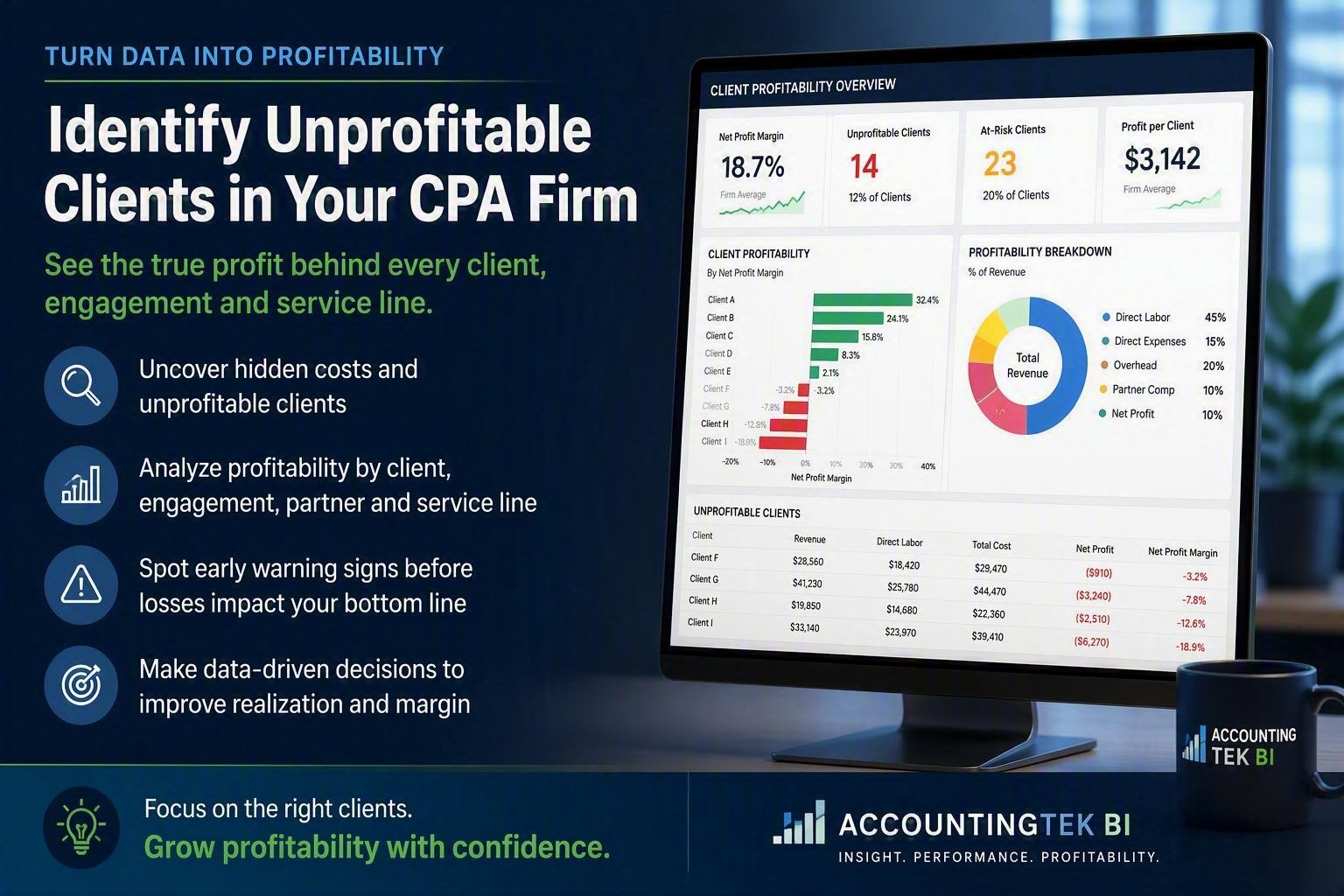
Client profitability dashboard for CPA firms

Client Profitability Formula

Client margin = fees collected − (hours worked × fully-loaded staff cost).

A client profitability analysis nets actual fees collected against the true cost of delivering the work — not the standard billing value, the fully-loaded cost of the staff hours involved. Two clients billing the identical fee can have very different margins if one takes twice the hours to service.

Effective Billing Rate

Effective billing rate = fees actually collected ÷ hours actually worked.

Effective billing rate is the clearest single early-warning signal for an unprofitable client: it's what the client is really paying per hour of work, after write-downs and collection issues, versus the firm's standard rate. A client whose effective billing rate has drifted well below standard is being quietly subsidized by every other client on the roster.

Cost Per Engagement

Cost per engagement = staff hours logged × fully-loaded hourly cost.

Cost per engagement is the input side of the profitability equation — what it actually costs the firm to deliver a specific engagement, independent of what was billed. Comparing cost per engagement to fees collected, engagement by engagement, is what turns "this client feels like a lot of work" into a specific number a partner can act on.

Engagement & Project Profitability

The building block client profitability rolls up from.

Engagement profitability (or project profitability, for firms running advisory and consulting work) measures margin at the individual job level. Client profitability is just the sum of engagement profitability across every job that client generated in a period — which is why one scope-creeping engagement can quietly drag an otherwise healthy client into unprofitable territory.

Margin by Client

Rank the book, don't just review it top-line.

Margin by client — not just revenue by client — is the view that actually reveals a firm's profitability mix. Ranking the client book by margin percentage, not fee size, routinely surfaces a small group of large, familiar clients quietly running at breakeven or worse, hidden by the fact that they're still large accounts on paper.

Client Profitability Dashboard

Ongoing visibility beats an annual client review.

A client profitability dashboard and project profitability dashboard connect directly to time, billing, and WIP data so effective billing rate, cost per engagement, and margin by client update automatically — instead of requiring a once-a-year manual analysis that's stale by the time the firm acts on it.

Client & Engagement Profitability Benchmark Reference Table
Metric Best-in-Class Target Warning Threshold Review Cadence
Effective Billing Rate 90%+ of standard rate Below 75% of standard rate Monthly by client
Client Margin 30%+ after fully-loaded cost Below 15%, or negative Quarterly by client
Engagement Budget-to-Actual Within 10% of budgeted hours Over 20% variance Per engagement

Four Signals That Flag an Unprofitable Client

  • Declining effective billing rate over time. A client whose effective billing rate has drifted down for two or more consecutive quarters is absorbing more write-downs relative to standard value — watch the trend, not just the current number.
  • WIP concentrated on one client. If a disproportionate share of aging WIP traces back to a single client, that's scope creep or collection friction the fee isn't covering.
  • Budget-to-actual variance that keeps growing. An engagement that consistently runs over its budgeted hours, quarter after quarter, is a client whose actual cost has quietly outgrown the fee it was priced against.
  • Realization rate below firm average for that client specifically. A client with below-average realization is being served at a discount relative to every other client on the roster, whether or not anyone decided that on purpose.

None of these signals show up in a top-line revenue report. They show up in client-level margin, effective billing rate, and WIP data — which is why accounting practice profitability requires more than the standard monthly P&L to actually diagnose.

FirmMetrics™: Client Profitability Surfaced Automatically

FirmMetrics™ already tracks the inputs a client profitability dashboard needs — realization, WIP, billing, and utilization by client — pulling directly from CCH Practice or Practice CS. That means effective billing rate and margin by client are visible without a separate annual profitability project, surfaced alongside the same realization and WIP KPIs partners already review weekly.

For partner-level and service-line profitability, see our Partner Performance & Service Line Profitability guide. For the full benchmark set, see our Accounting Firm KPI Benchmarks guide.

Client Profitability: Frequently Asked Questions

How do I know which clients are unprofitable?

Rank the client book by margin percentage, not revenue — a client profitability analysis that nets fees collected against the fully-loaded cost of staff hours. Watch four signals specifically: declining effective billing rate, WIP concentrated on that client, growing budget-to-actual variance on their engagements, and below-average realization rate for that client relative to the firm.

What is client profitability analysis?

Client profitability analysis nets the fees collected from a client against the true cost of the staff time it took to deliver the work, rather than just reviewing revenue by client. Two clients with identical fees can have very different profitability if one takes significantly more hours to service.

What is effective billing rate and why does it matter?

Effective billing rate = fees actually collected ÷ hours actually worked. It's what a client is really paying per hour after write-downs and collections, versus the firm's standard rate. A steadily declining effective billing rate for a specific client is one of the earliest signals that account has become unprofitable.

What is cost per engagement?

Cost per engagement = staff hours logged on that engagement × fully-loaded hourly cost. It's the input side of profitability — what it actually costs the firm to deliver a job, independent of what was billed — and it's what turns a partner's sense that "this client feels like a lot of work" into a specific, comparable number.

How is engagement profitability different from client profitability?

Engagement (or project) profitability measures margin at the individual job level. Client profitability is the sum of engagement profitability across every job that client generated in a period — so one scope-creeping engagement can drag an otherwise healthy client into unprofitable territory even while most of its work stays on budget.